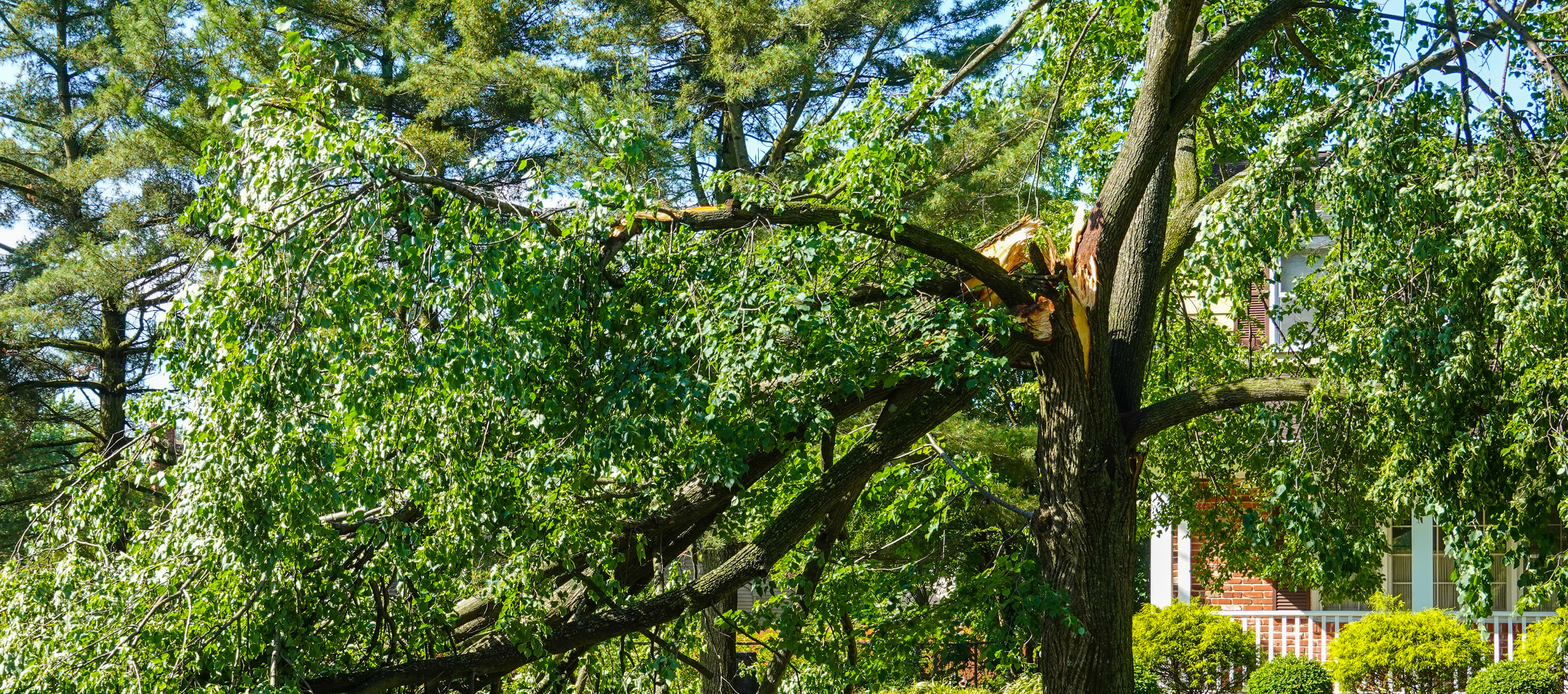
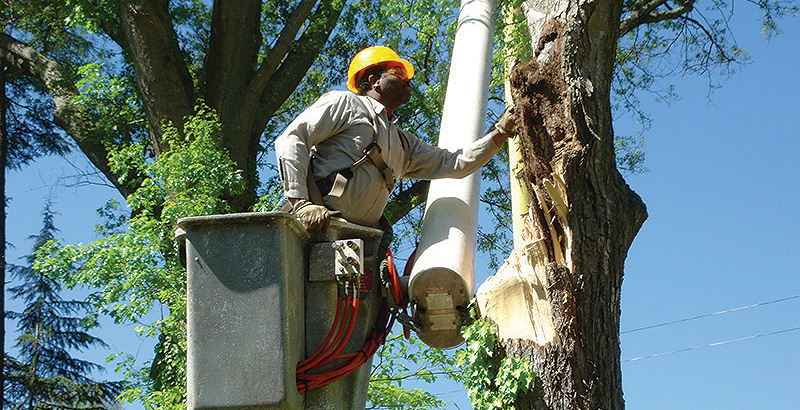
Large trees provide many benefits for properties in terms of value and aesthetics. The downside of large trees is that they can shed branches or that their branches may break in storms. Over the past decade there has been a substantial amount of research on how and why trees fail. Bartlett’s goal is to identify conditions that may predispose a branch to failure so that actions can be taken to reduce the likelihood of these failures.
Co-dominant stems
One of the more common types of failures is that due to co-dominant stems. Co-dominant stem unions occur when the main stem “forks” into two or more large branches. Research on these unions shows that they have approximately half the strength of a trunk without co-dominant stems. Sometimes these unions have bark trapped within the diverging stems. This “included bark” drastically weakens the branch union further. A crack where the stems diverge indicates that the junction has likely begun the process of failing.
“Structural pruning” while the tree is still immature is the absolute best way to avoid failure due to co-dominant stems. This process involves selecting the strongest, most centrally located branch to become the dominant stem. Other branches competing with this stem are removed or reduced in length in order to subordinate them. Characteristics of the specific tree species will dictate the required frequency and intensity of this structural pruning.
Research shows that branch subordination necessitates the removal of at least half the length of the branch; removal of less will not slow the growth sufficiently.
For mature trees that have not been properly pruned, supplemental support systems, which limit the movement of the stems and substantially reduce the risk of failure, may be recommended.