

Bacterial Leaf Scorch
Xylella fastidiosa
Bacterial Leaf Scorch (BLS) is a chronic tree disease caused by the bacterium Xylella fastidiosa. BLS affects the vascular system, restricting the transportation of water within the infected plant. The result is a slow, but progressive decline in health.
The bacterium multiples as the weather warms, reaching a peak by late summer. It is spread as certain insects including leafhoppers, spittlebugs and treehoppers feed on an infested tree and then move to a healthy one.
Common hosts include oak (particularly red, pin, black, scarlet, and southern red), sycamore, American elm, oleander, and mulberry. The disease is also seen in red and sugar maples, sweetgum, dogwood, olive, pecan, and other oak species (swamp white, bur, and willow).
Affected Areas
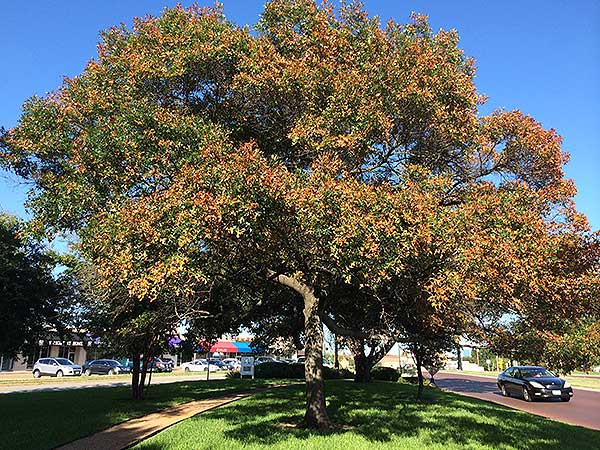
An oak tree in the later stages of Bacterial Leaf Scorch shows symptoms throughout the canopy.
BLS is a common disease throughout most of the eastern United States from New Jersey south to Florida. It is also prevalent moving westward to Texas and California. Many strains are sensitive to cold and thrive best where winters are mild. The pathogen that affects oaks may be more tolerant of cold. It is well-established and widespread in parts of New Jersey. Isolated cases have also been reported in Midwestern states including Indiana, Illinois, Ohio, and Nebraska.
Symptoms
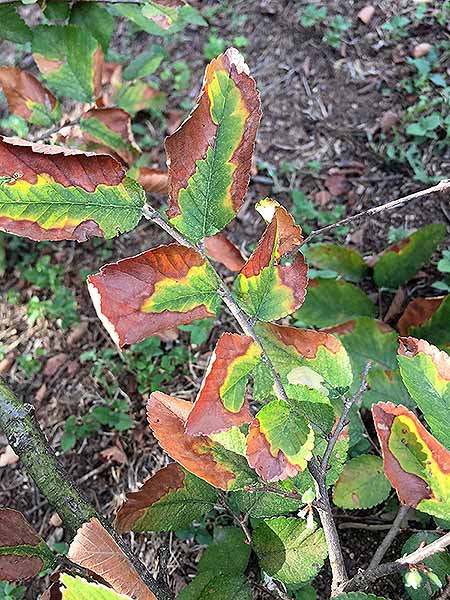
The first symptom of Bacterial Leaf Scorch is irregular brown edges accompanied by a "halo" of orange, red or yellow.
When BLS is present, the leaf margins receive insufficient water and the tissue begins to die. As this occurs, leaves become brown along the outer edges. This is called leaf scorch or marginal leaf burn. There is often a "halo" of red, yellow, or orange along the inside of the brown, scorched edges. Symptoms rapidly escalate in late summer and loss of leaves follows quickly thereafter. During the first years of infection symptoms will often only appear on a few branches, but become progressively worse over time. The tree declines slowly for up to a decade or more until the entire tree turns brown.
Control
There are a number of other tree issues that present initial symptoms similar to BLS including drought and heat stress. To ensure appropriate treatment, it is important to first properly identify the cause. With DNA analysis, BLS can be detected at any time of the year — even when symptoms are not readily apparent. Annual treatments can help suppress symptoms and provide control for insects known to spread the disease. Trees in advanced stages of decline should be removed to help minimize spread of Bacterial Leaf Scorch to nearby trees.